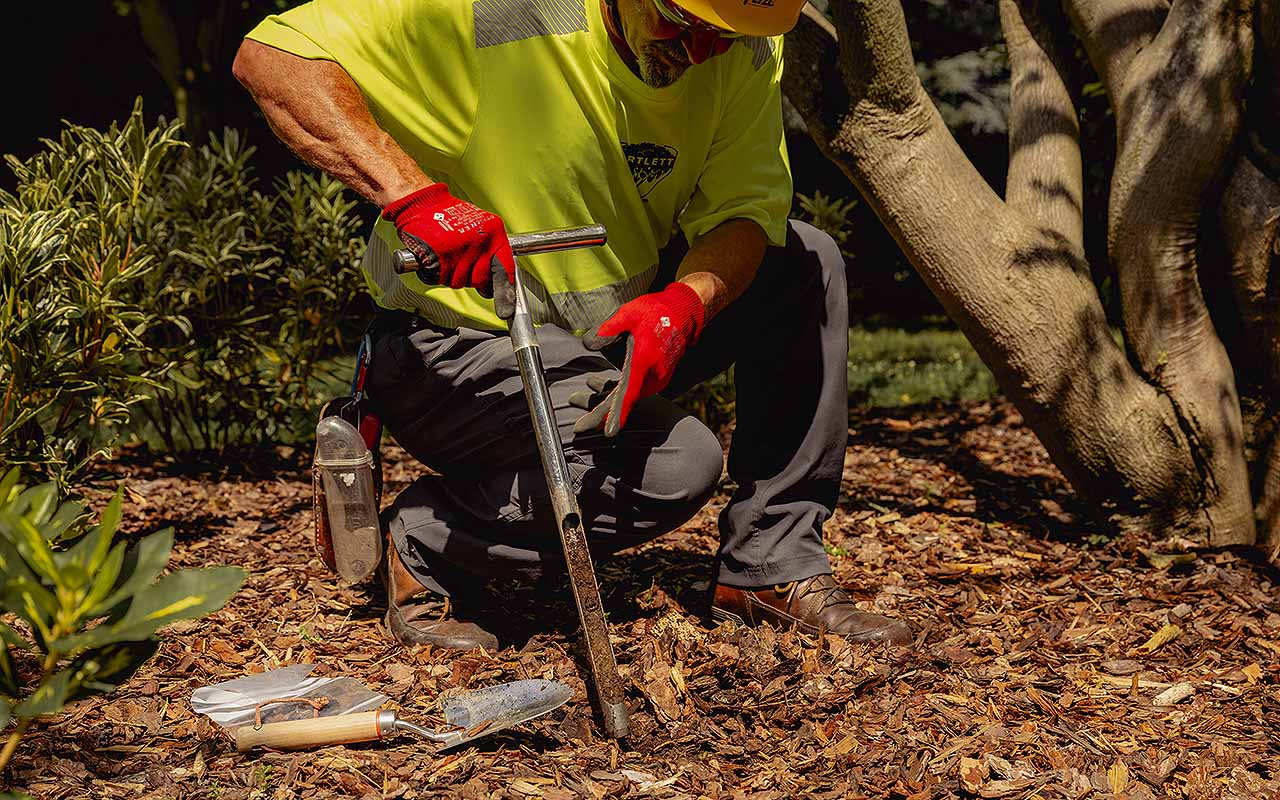
A decade ago, tree root zone management was not considered a service. Today, due to advancement in both soil excavation tools and technologies, Bartlett is able to provide a variety of treatments to encourage root development, as well as to prevent root encroachment and damage beneath pavements and driveways. Homeowners frequently ask about treatments to eliminate surface roots of trees especially in lawn areas. Certain species, such as sycamore, birch, and cherry are inherently shallow rooted and more prone to producing surface roots. Surface roots are more common in heavy clay soils compared to sands or loams. Frequent light irrigation can also increase the likelihood of trees developing surface roots. Once surface roots become a problem, there is little that can be done to correct the condition. Cutting the roots can impact tree health and stability and roots are likely to grow back if the tree survives.
Most trees species will tolerate covering the offending roots with eight to ten centimetres of loam soil but as the roots grow in diameter, they will again reappear on the surface. If soil is added, make sure it is not placed on the root collar and against the stem. The ideal option for dealing with surface roots is to mulch the area beneath the tree crown to avoid conflict between tree roots and grass.
Bartlett’s premier service is Root Invigoration, a process developed by scientists at the Bartlett Tree Research Laboratory. Root Invigoration uses a unique process that concentrates a high volume of air on a small area of soil. This acts to loosen dense soil and allows the incorporation of composts and other necessary amendments to promote root development on trees stressed by soil compaction, root damage, or root disease.
Air-tools are also used to rapidly remove soil and mulch that have been placed against the root collar and stem tissue during planting, construction, and maintenance. The root collar, which is the area where the root system joins the stem, should remain free of soil and mulch to reduce the risk of disease and insect infestations, as well as the development of stem girdling roots.
There are several types of root barriers that are now available that will restrict development of tree root systems beneath pavements to prevent lifting. Barriers are comprised of high-density plastic or fabric that are impregnated with an herbicide to inhibit root growth.