

Fire Blight
Highly destructive and difficult to control
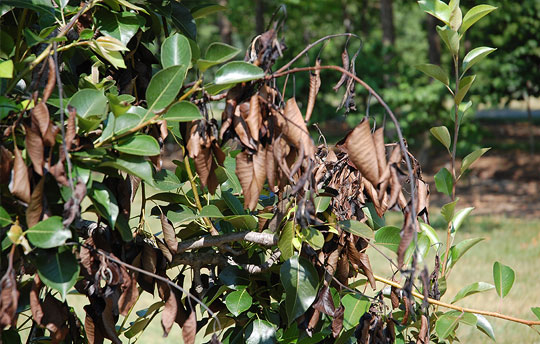
Fire blight
Fire blight is a tree disease caused by the bacterium Erwinia amylovora. Impacting pear, apple, crabapple, cotoneaster, mountain ash, hawthorn, pyracantha, spirea, and many species in the rose family, it is highly destructive and difficult to control.
Outbreaks occur in spring as the bacteria multiply. When weather is warm and humid, the infection spreads quickly to new growth including shoots, fruit, and blossoms. Blossoms wilt and die within two weeks of infection. Fire blight can lead to loss of major branches or the death of the entire plant. Young, actively growing plants are at the highest risk.
Symptoms
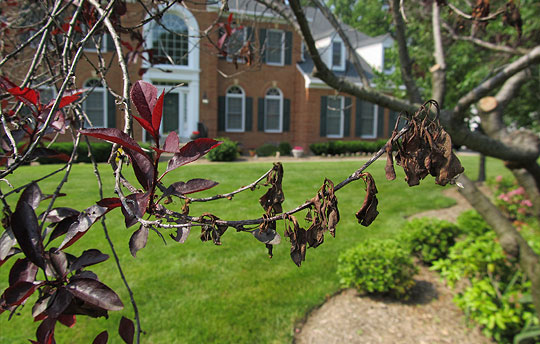
The ends of infected branches take the shape of a shepherd's crook. Damaged leaves remain attached.
The disease gets its name from the 'scorched' appearance of leaves. Wilting and blackening/browning of the leaves is commonplace and easily observed. The ends of infected branches are often bent over to form a crook with damaged leaves still attached. Impacted blossoms will look water-soaked or discolored. Fruit may develop lesions or appear small, dark, and shriveled. Over time, black bark, and cankers will develop, where the bacterial ooze can be spotted during humid weather.
Control
Given the difficulty in controlling fire blight, an integrated approach is the best solution. This includes well-timed pruning to remove infected branches as well as fertilization based on soil analysis using only slow-release nitrogen products. (Too much nitrogen will result in vigorous growth that is highly susceptible to infection.) Foliar bactericide application during the dormant season and at flowering will reduce blossom infections. A soil-injected treatment will reduce shoot blight, but must be applied between the time when buds appear and when petals fall.