

Powdery Mildew
An unsightly nuisance
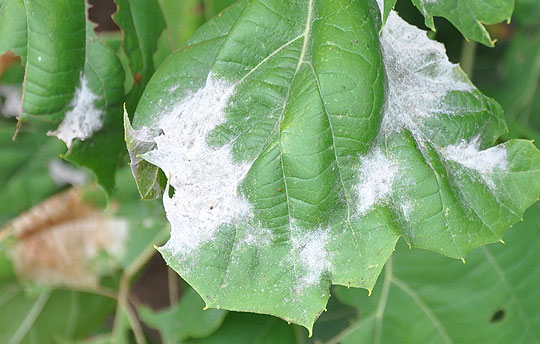
Powdery mildew on leaves
Nearly all ornamental trees and shrubs are susceptible to a foliage disease called powdery mildew. Though the disease typically does not permanently damage plants, it does make them unsightly. Especially given that commonly affected species like rose, dogwood, lilac, and crape myrtle are often added to landscapes for their showy appearance, the presence of powdery mildew can be a persistent and exasperating nuisance.
Symptoms
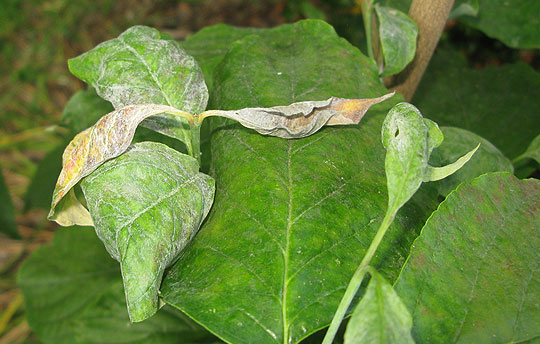
Curling of leaves sometimes accompanies a white, powdery coating on plants infected with powdery mildew
As the name implies, white or grey powdery spots or growth can be seen on leaves, stems and flowers. Curling and stunting of the youngest leaves, as well as the developing stems, is also commonplace on infected plants. Depending on the species, mature foliage may have some red or purple discoloration.
Control
A combination of tactics are necessary to manage powdery mildew. Infected leaves should be gathered and destroyed in autumn. Pruning will promote air circulation and improve light penetration, discouraging growth of fungi. Fertilization should be completed in the dormant season to help prevent excessive late-season growth that is most susceptible to the disease.
As this is a pervasive disease, regular fungicide treatments applied as soon as symptoms appear will provide effective control.