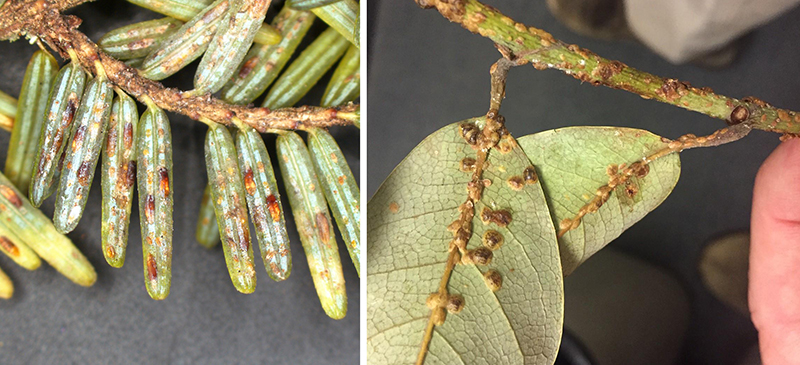


Armored scales (family Diaspididae) and soft scales (family Coccidae) are common pests on many deciduous and coniferous trees and shrubs. Hosts in urban environments often develop more damaging infestations. The two primary differences between these groups are how the protective covers are formed and where feeding occurs.
Armored scales secrete a waxy covering that is separate from their bodies and grows larger with each successive molt. This cover can be flipped over to permit microscopic identification of the scale species. Soft scales do not have a separate cover but secrete a waxy coating onto their bodies that provides similar protection. Scale feeding reduces plant vigor, and large populations can result in dieback throughout the infested areas of the canopy. Armored scales feed in parenchyma cells, which serve many functions, including nutrient storage for plants. Soft scales feed in the phloem and, as a result, excrete a significant amount of sugary waste known as honeydew. This substance is commonly colonized with sooty mold fungi that can leave a black coating on affected surfaces. If you think you have a scale infestation or want more information, call your local Bartlett Arborist Representative.